Fire crews reopen the riverside route after overnight flooding
Common Current story
NASA Navigation Experiment Shows Promise for Planetary Landings
NASA successfully demonstrated technology designed to help spacecraft autonomously navigate to safe landing sites on the Moon and on other planets. An Alta-X…
Author not supplied
· Published 04 Nov 2026, 17:10 · Updated 04 Nov 2026, 17:10
Credit: NASA · NASA material is generally not copyrighted; items carrying a third-party or copyright credit are excluded. The NASA logo and insignia are never reused.
NASA3 min readPreparations for Next Moonwalk Simulations Underway (and Underwater)
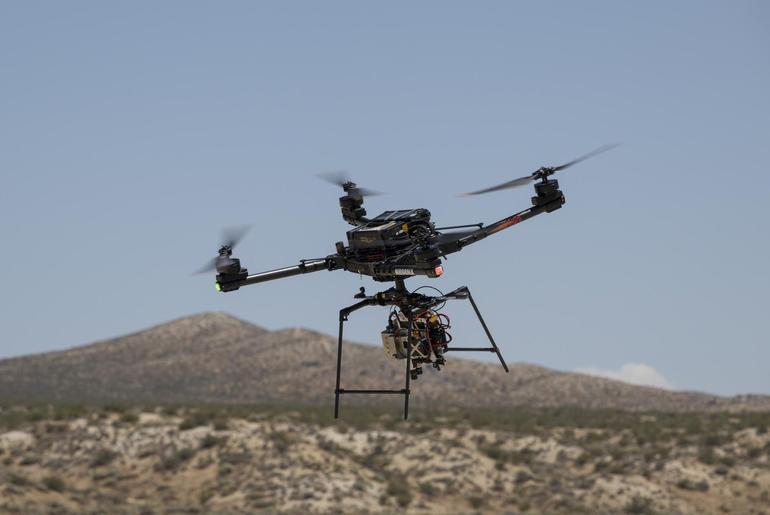
An Alta-X drone flies an advanced guidance and navigation system known as the Safe and Precise Landing – Integrated Capabilities Evolution (SPLICE) experiment near NASA’s Armstrong Flight Research Center in Edwards, California, on Wednesday, July 15, 2026. Researchers at NASA’s Johnson Space Center in Houston developed SPLICE, which successfully communicated with the remotely piloted aircraft during hover maneuvers in flight. SPLICE will help spacecraft land precisely and detect and avoid potential hazards, which is critical for NASA missions to the Moon and to Mars.NASA/Ryan Kline
NASA successfully demonstrated technology designed to help spacecraft autonomously navigate to safe landing sites on the Moon and on other planets.
An Alta-X drone equipped with the agency’s Safe and Precise Landing – Integrated Capabilities Evolution (SPLICE) guidance, navigation, and control payload completed simulated lunar descent and landing maneuvers Aug. 27. The flight took place at Rogers Dry Lake near NASA’s Armstrong Flight Research Center in Edwards, California.
During the tests, the SPLICE payload used an advanced guidance system to map the terrain and assess potential landing areas. If the system determines the targeted landing area is unsafe, the system diverts the drone to a safer location. The system generates high-resolution digital elevation maps from light-detection and sensor data.
Davis Adams, project manager, confirms that an advanced guidance and navigation system known as the Safe and Precise Landing – Integrated Capabilities Evolution (SPLICE) experiment is communicating with an Alta-X drone near NASA’s Armstrong Flight Research Center in Edwards, California, on Wednesday, July 15, 2026. Researchers at NASA’s Johnson Space Center in Houston developed SPLICE, which successfully communicated with the remotely piloted aircraft during hover maneuvers in flight. SPLICE will help spacecraft land precisely and detect and avoid potential hazards, which is critical for NASA missions to the Moon and to Mars.NASA/Ryan Kline
Researchers at NASA’s Johnson Space Center in Houston developed the SPLICE payload and partnered with specialists at NASA Armstrong to integrate, test, and fly it aboard the Alta-X drone in June and July. Those tests verified communications, data handling, telemetry, and command- control performance between the SPLICE payload and the drone to prepare for a full-scale test at Voyager Technologies in Mojave, California, later this month.
“This flight test is the culmination of almost a decade of work, for the SPLICE project,” said Davis Adams, NASA project manager. “This flight raised the technology readiness level, priming it for integration into future robotic and crewed lunar flights. Validation of the guidance and navigation systems are applicable to terrestrial, lunar, and Martian descent and landing missions.”
NASA has worked with a number of commercial lunar lander providers to implement iterations of SPLICE into their platforms. A number of the landers slated for upcoming Moon Base missions leverage data collected by NASA through the development of systems like SPLICE to execute soft touchdowns on the lunar surface.
Justin Link, a small uncrewed aircraft pilot, left, Justin Hall, chief pilot, and Davis Adams, project manager, test an advanced guidance and navigation system known as the Safe and Precise Landing – Integrated Capabilities Evolution (SPLICE) experiment on an Alta-X drone near NASA’s Armstrong Flight Research Center in Edwards, California, on Wednesday, July 15, 2026. Researchers at NASA’s Johnson Space Center in Houston developed SPLICE, which successfully communicated with the remotely piloted aircraft during hover maneuvers in flight. SPLICE will help spacecraft land precisely and detect and avoid potential hazards, which is critical for NASA missions to the Moon and to Mars.NASA/Carla Thomas
“We are coordinating with industry regarding the usage of the guidance system once the system is available in the NASA software catalog, currently planned for this fall,” Adams said. “Some of the companies also are evaluating the system’s navigation capabilities for precision landing applications, as well as potential extensions for autonomous surface mobility.”
NASA’s Flight Opportunities project, based at NASA Armstrong, enabled flight testing of the SPLICE project early in its development that laid a foundation for it to continue advancing its technology readiness level to what it is today. Flight testing included both a descent altitude and a landing trajectory in 2019 similar to what is expected on a lunar mission and the demonstration of two NASA-developed precision landing sensor systems in 2020.
Explore More
6 min read
Happy 65 Years: NASA’s Johnson Space Center Then and Now
Article
2 days ago
1 min read
Halloween Aboard the International Space Station
Article
6 days ago
4 min read
NASA University Challenge Ignites Trajectory of Drone Entrepreneur
Article
7 days ago
Keep Exploring
Discover More Topics From NASA
Armstrong Flight Research Center
Aircraft Flown at Armstrong
Research and Technology Mission Directorate
Technical Capabilities